|
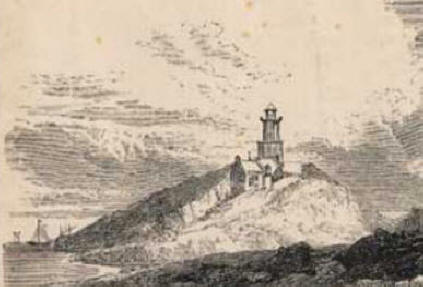
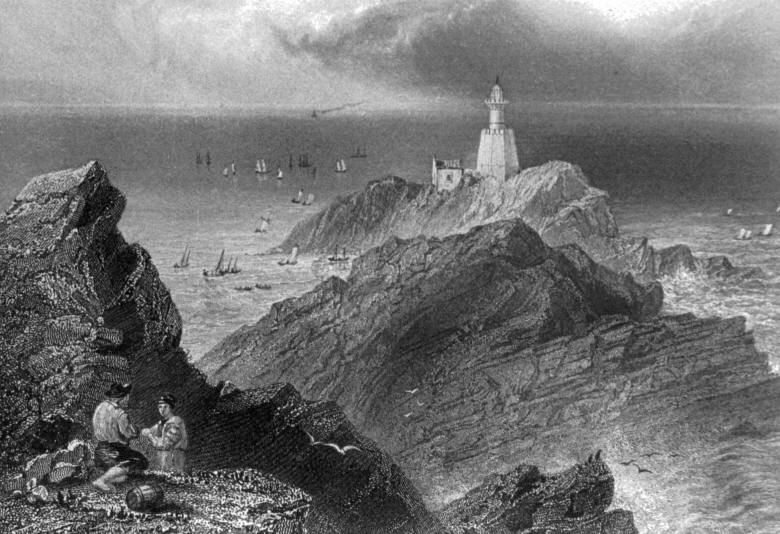
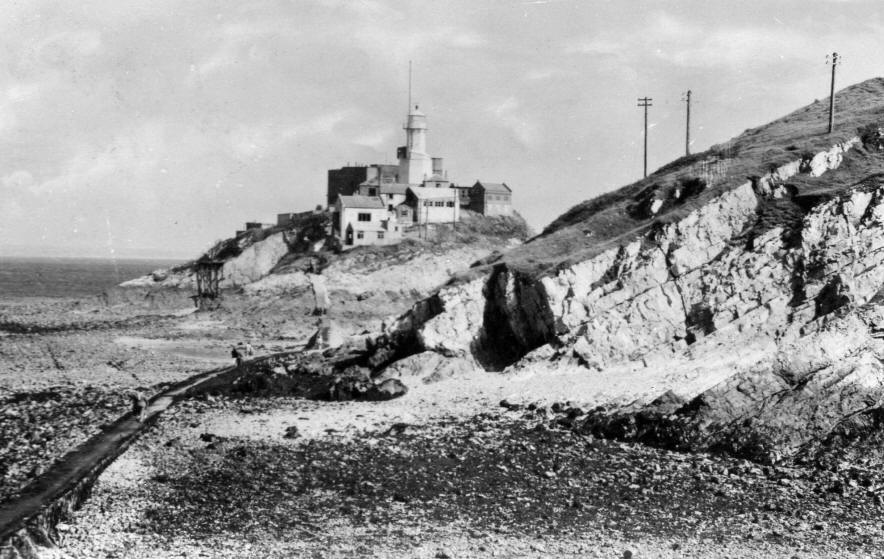
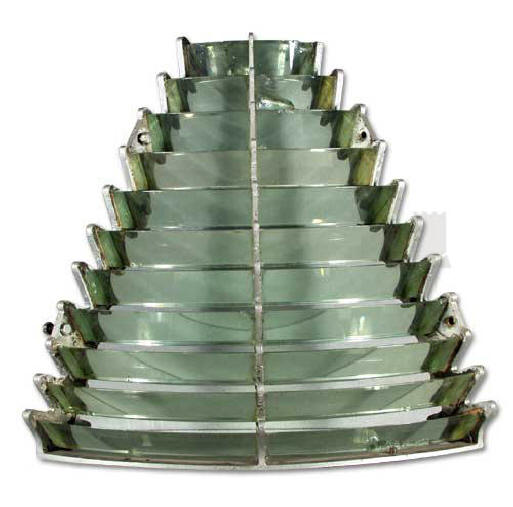
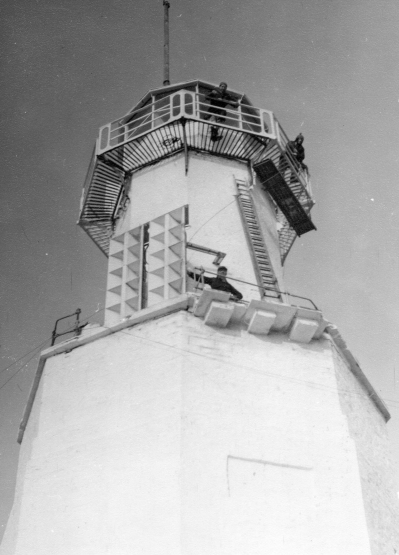
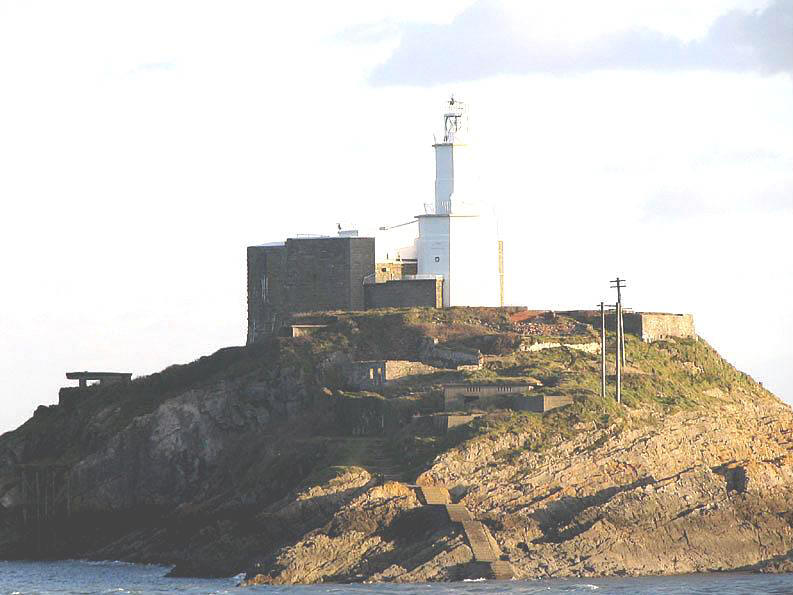
The Harbour Act of 1791 empowered the Swansea Harbour Trust to construct a lighthouse on the outer islet of Mumbles Head for the purpose of warning ships of the dangers of the nearby Mixon Shoal sandbank and the underwater reef known as Cherrystone Rock. Construction began in July 1792, but the initial work was of a very poor standard and the half-completed structure collapsed in the October of that year. In 1793 the Swansea Harbour Trust accepted new plans drawn up by prominent Swansea architect William Jernegan, and the Mumbles Lighthouse was eventually completed in 1794. It comprised a stone tower 56 feet (17 metres) in height which originally housed two open-fire braziers - one at the top of the tower and the other on a ledge set some 20 feet (6 metres) below. In 1798 the two coal braziers were superseded by a lantern set on top of the tower to house a revolving light made up of twelve oil-powered Argand lamps fitted with reflectors, and in 1860 the lighthouse was fitted with a dioptric lens which greatly magnified the light, making it light visible for up to 15 miles in clear weather. The original set-up of 12 Argand lamps was changed in 1880 to a system of 3 Argand lamps made by Chance & Bros. of Birmingham, and some years later this system was discarded for a Kitson & Chance single incandescent mantle burner (this would probably have been in the mid 1890's). The incandescent burner was fed by paraffin (kerosene) and compressed air, and consumed a pint and three quarters of paraffin per hour. The occultation system which enabled the light to flash was introduced in 1905, and consisted of a metal cylinder which was raised and lowered around the light by a gravity-driven mechanism powered by large weights which had to be hand-cranked to the top of the tower by the lighthouse keeper. In 1935, however, the lighthouse was converted from paraffin to electricity and fitted with a new automatic control system, and from that point on the role of the lighthouse keeper was no longer required. In 1969 the dioptric lens was removed and a standard navigation light fitted to replace the original Edison screw lamp. For many years the dioptric lens was on display in the old Maritime Museum but, like so many important local historical artefacts, it now languishes sadly in the Swansea Museum storehouse. By the early 1980's the lantern itself had deteriorated to the point where it was unsafe and had to be removed, but public opinion regarding the appearance of the lighthouse without its traditional lantern resulted in the fitting of a replacement from Lightship No. 25 a few years later. The Swansea Harbour Trust owned and operated Mumbles Lighthouse until 1923, when the lighthouse was transferred to the Great Western Railway as part of the company’s take-over of Swansea Docks. It remained in the ownership of the GWR and its successors - the British Transport Commission and the British Transport Docks Board - until 1976 when it was finally taken over by the Corporation of Trinity house.
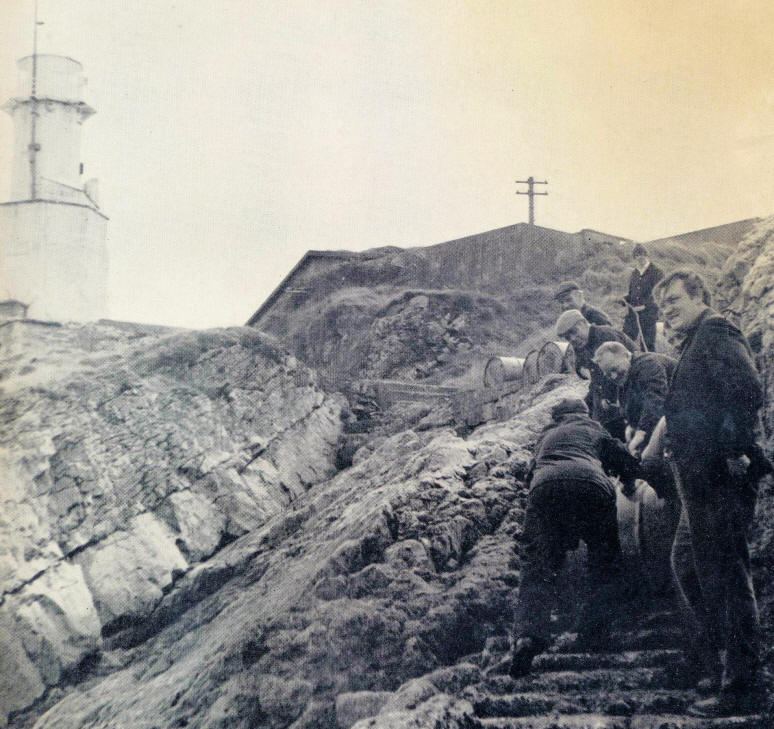
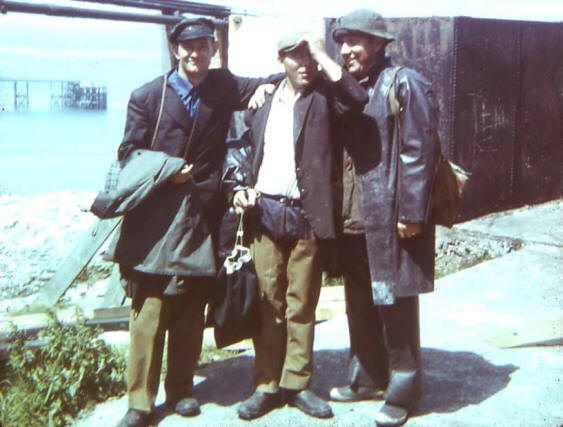
Prior to Trinity House taking over control of the Mumbles Lighthouse in 1976, all maintenance was carried out by the Civil, Mechanical and Electrical Engineering Departments of Swansea Docks. This work was done regularly every Friday and, providing there were no other faults reported by the Coast Guards, would be sufficient to keep the light going for the week. The Electricians allocated to do this maintenance lived in or near the Mumbles and would be available to respond to any call out that may occur. The engineering workshops were originally based in Harbour Road and, in the old days, the workmen would travel to the lighthouse on the Mumbles train, together with their tools and any spares that may be required. However, in later years, the various engineering departments were issued with vans and, after the South Dock closed, the Harbour Road workshops were relocated to the Kings Dock.
On the outer island where the lighthouse
is located was a small workshop and a mess room, but no drinking water, so
fresh water had to be carried across to make the tea. In case the men were
cut off by the tide, a supply of tinned food (beans, corned beef etc.) was
kept in the workshop stores. There were occasions when some of these
emergency rations were eaten by anonymous persons who were feeling a little
hungry. If this was not spotted and replaced, anyone who was cut off by the
tide would have to make do with just a cup of tea. This did not take long and, on the 21st October 1794, Benjamin Llewellyn was appointed keeper at 18 shillings (90p) per week. Following on from Benjamin Llewellyn, three Abraham Aces, grandfather, father and son looked after the light for the next three-quarters of a century - the last Abraham Ace retiring in 1902. Jasper Williams took over the duties until 1914 when he was succeeded by his assistant John Thomas, who continued until 1923 when the ownership of the lighthouse was taken over by Great Western Railway as part of the take over of the Swansea Harbour Trust. The last two lighthouse keepers were Charlie Cottle and Joe Hunt, who were made redundant in 1936 after the lighthouse had been converted from oil to electricity and fully automated.
A gun battery was built alongside the lighthouse in 1861 by the War Department to guard the Port of Swansea against the possibility of a French invasion. The original battery housed five 80-pounder guns and had accommodation for a Staff Sergeant and a corps of 21 men. At the end of the nineteenth century the original 80-pounders were replaced by two .303 Maxim machine guns and two QF (quick-firing) Mark III naval guns with a calibre of 4.7". In 1942 these weapons were replaced by two more modern 4" BL Mark VII French naval guns. The gun battery at Mumbles Head was eventually decommissioned in 1957.
|

|
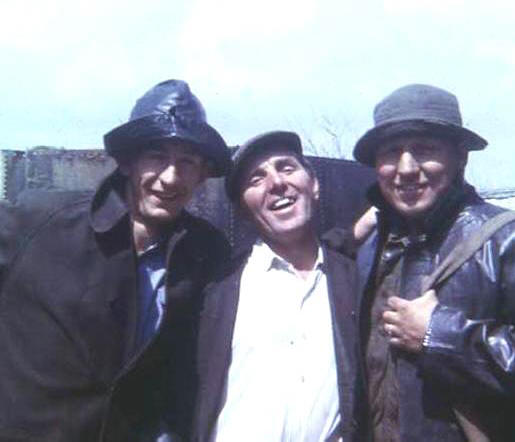
Albert Hopkins (left) pictured
with one of the last two lighthouse-keepers, Charlie Cottle,
|


The first lighthouse coal burning 1794
In 1798 converted to oil burning Argand
lamp and in 1860 upgraded
to Kerosene
The occultation system was installed in
1905